Thursday, October 17, 2013

The 2013 Buddy Walk

2013 was our best Buddy Walk year yet!  We set our fundraising goal a little higher from last year, at $1,900 and we ended our fundraising efforts at $2,415!!!!!!!  That is AWESOME!  We even had 30 walkers the day of the Buddy Walk! 
 
I am so thrilled with all of the support that we were given this year!  It means SO much to me and my family that so many people support us as a family and support Sophia as an individual with Down syndrome.  The Buddy Walk is such a special time for our family.  It gives us a chance to raise awareness and to rally behind our little girl and all the other individuals with Down syndrome and show our love and support for this awesome community! 
 
I hope that you all know how grateful and appreciative we are to everyone who donated, bought a shirt, and to those of you who took time out of your Saturday to come all the way to Indianapolis and walk with us....it means the world to us!  All of you make this day even more special for us!  We love you all!! 
 
I know that our family is already looking forward to another great day in 2014, and I hope you are too!!!!! 
 
Daddy, Jayden, Mommy and Sophia :)
 
Celebration Plaza
 
The Star herself....Miss Sophia

Sophia and Jayden

Daddy and Sophia

Our team lining up for the walk...Go Team Sophia's Stars!

Cousins (and a few cheerleaders)

Jayden and her cousin doing the YMCA

taking a break to roll down the hill....it's a tradition :)
 
Sophia and Lizzie

Aunt Jarah, Mallory and Soph

Walking along the canal

The Canal
 
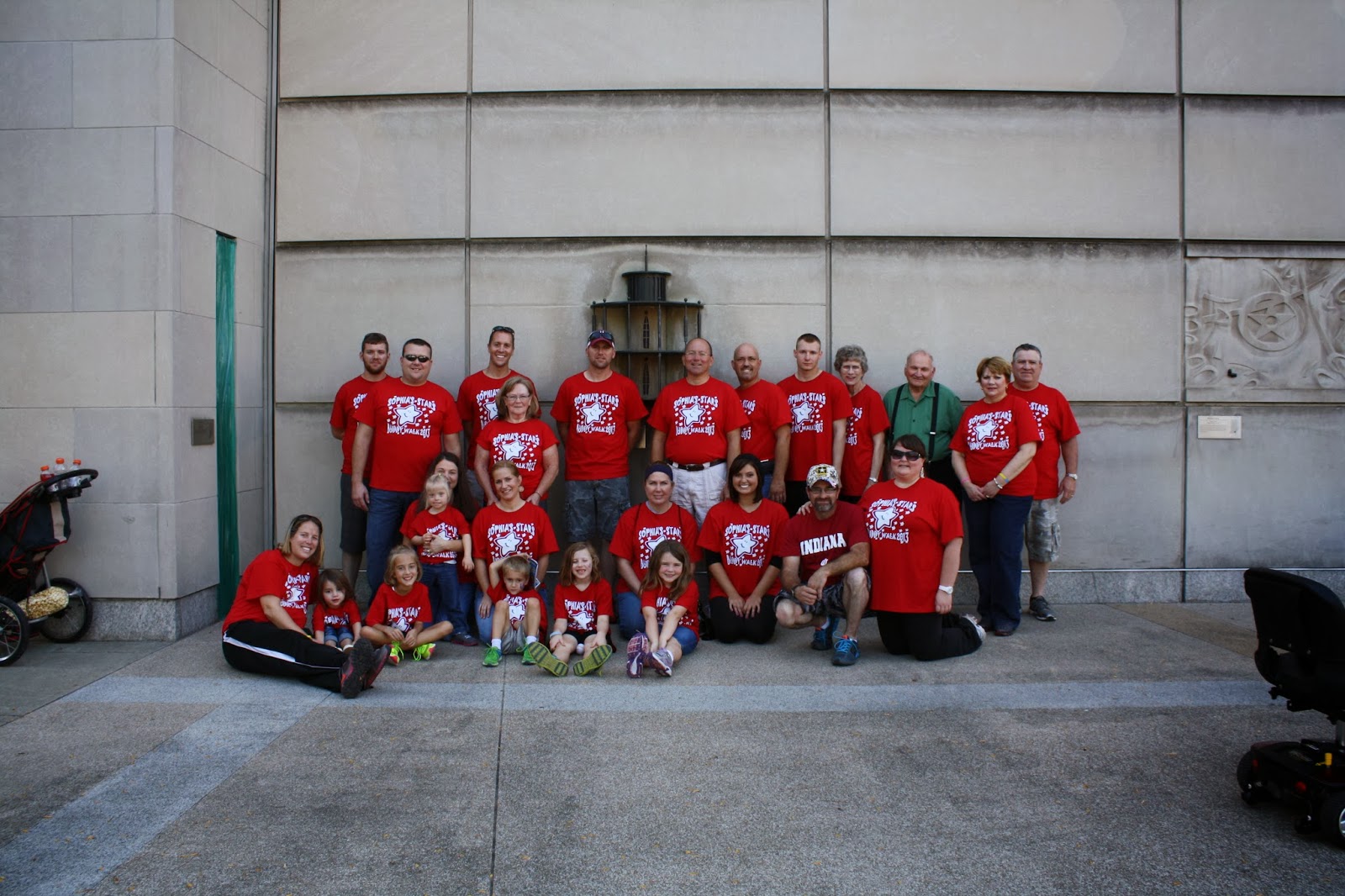
2013 Team Sophia's Star

Our little family :)
 
The End :)
 

Wednesday, October 16, 2013

Wordless Wednesday

Just a little side note: As much as this beast of a dog gets on my nerves, she has to be one of the BEST dogs ever!  She puts up with A LOT of crap from this little peanut!   


Tuesday, October 15, 2013

Your child has Down syndrome....Now what?

I can still remember that moment in the delivery room.  My OB/GYN and the neonatologist came into my room after Sophia had already been taken down to the nursery and they informed me, with long, sad faces, that they suspected my daughter had Down syndrome.......

I remember waiting for the rest of the story.  There had to be more to it than just that.  Especially by the looks on their faces, there just had to be something else that they weren't telling me.  But right then, that was it.  I can honestly say that I had no idea what that really meant in that moment.  An image came into my mind after hearing the news, but that's all I knew.  I had just seen my daughter moments before.  I had held her and told her I loved her and looked into her beautiful blue eyes and I saw nothing.  Nothing except an absolutely perfect little piece of Heaven. 

Soon after that we were told of some medical issues that Sophia had and she would be getting transferred the following day to the closest Children's Hospital.  This is when all the real fun began.  We spent the next month just trying to function day to day, with normal life as we once knew it and this new life of hospitals and monitors and tubes and surgeries....It was hard.  But our focus was on our baby and getting her healthy enough to bring home.  In these first few moments, Down syndrome was the least of our concerns. 

When Sophia was healthy enough to come home, things began to get real.  Of course my main concern was just taking care of my new baby and loving her, but was that really enough?  Yes and no.  She needed me to be a mom.  She needed all the love and attention I had to give to her.  She needed talked to and cuddled and fussed over, just like any newborn baby, but she also needed more..... 

First Steps:  An in home service that provides trained therapists to come and work with your child on meeting milestones from the ages of birth to 3 years.  Therapy was very important for Sophia, and still is.  Milestones that so many parents take for granted, are a lot of work for babies with Down syndrome to meet.  Getting your child started with therapy is so important, especially from the very beginning.

Medicaid Disability and the Waiver program:  I knew that our family didn't qualify for Medicaid, so I saw no reason to go and fill anything out.  Then one day, by chance, I ran across a table set up at the Children's Hospital and they had information about waivers.  No one had ever mentioned anything about a waiver or what that meant.  But I soon found out that waivers are not based on the parent's income, but the child's income....which was nothing.  I was told, that even though we wouldn't qualify for Medicaid based on our income, we still needed to go and fill out an application for Medicaid so that we could apply for the Medicaid waiver.  Basically a Medicaid waiver can provide your child with additional services as they grow.  There is a pretty long waiting list for some of the waivers, which is why it is important to get your paperwork filled out early.  For more information on waivers, you can call your local Bureau of Developmental Disabilities Services (BDDS) office or even contact someone more knowledgeable from Family Voices Indiana or ASK to help you in the process. 

See Specialists:  If your baby was born pretty healthy, you may not realize that children with Down syndrome can have some health issues, more so than your typical kid.  Its a good idea to check in with some specialists to make sure that everything is working the way it should.  The Down Syndrome Clinic at your nearest Children's Hospital is a good place to start.  They have doctors who specialize in the care and well being of individuals with Down syndrome.  Other specialists to consider seeing would be a Cardiologist and a Pulmonologist.  A lot of children with Down syndrome have heart defects, some that require surgery, and others that heal on their own.  Making sure that your child has a healthy heart is very important.  A lot of children, and adults, with Down syndrome have sleep apnea or other pulmonary issues.  So having a sleep study done if you notice any unusual sleep patterns or breathing issues is very important as well.  Your child should have his or her hearing checked every 6 months in the beginning and an annual eye exam.  Some other tests to consider having annually, and these can be done at your local pediatricians office too, are having your child's thyroid checked, doing a complete blood count (CBC), and testing for Celiac Disease.  We love our local pediatrician, but we have found great comfort in having our daughter monitored and check annually at the nearest Children's Hospital.  They specialize in kids with special needs, whatever those needs might be, and staying one step ahead of your child's health is always important. 

Look into a Special Needs Trust for your child's future:  Setting up a will and planning for your child's future, should something ever happen to you and your spouse, is something most parents think about.  But when you have a child with special needs, who is dependent on government assistance, or will be when they turn 18, it's important to have all your ducks in a row should you and your spouse not be there to care for him or her.  Leaving money to your children is a great thing.  But leaving money to a child with special needs, can be the worst thing anyone could do.  Don't get me wrong, you can leave money to your child with special needs, and you should leave money to your child, but you have to be very careful with how you leave your money to your child with special needs so that you don't effect their services that they may be receiving from the government.  A child with special needs is only allowed to have $1500, I think, in their name before it can effect what they receive from the government.  If they have more than that, they can be cut from all services they are receiving and in turn have to drain their savings in order to continue getting therapies, providing expensive healthcare for their health needs, and anything else they may benefit from in order to possibly be as independent as possible.  Lets just say, that savings will drain out very quickly, leaving your child with no money and back on a long waiting list to get their government assistance back.  And what do they do in the mean time?  With a special needs trust, your child can benefit from the assistance provided by the government and have their own little nest egg for things they may enjoy doing in the community or to travel to see family or whatever!  Setting up a special needs trust is easy, but you do need to see a financial planner/attorney who specializes in doing such things.  The wording of the trust is VERY IMPORTANT.  When we set up Sophia's trust, we went through MetLife, out of Indianapolis.  We met with a financial planner, who worked hand in hand with an attorney, who set up  our will and our trust for Sophia in a way that will only help her should something ever happen to my husband and myself.  A special needs trust can be a little costly, but it is worth every penny!  To know that your child will be taken care should anything ever happen to you, is priceless.  There are also payment plans that can be worked out and you can usually receive a free consultation, just to find out more about the special needs trust and your specific circumstances revolving your finances and your child(ren).  Of course this isn't something that we ran out and did immediately, but something to consider sooner rather than later.   

Most importantly, LOVE YOUR BABY FIRST!  Your child with special needs is a child first and foremost.  He or She needs love and affection above all else. 

Educate yourself on your child's special needs and his or her diagnosis.  This will help you to advocate for your child better.  You may be the only voice your child has...you'll need to use it!

Get support.  Not just for your child, but for you.  You need a strong support system in order to help you stay strong for your child.  If it's family, great!  If it's close friends, awesome!  If it's an online support system, fabulous!  Any kind of support that you can get will only help you push through those hard times and come out standing taller on the other side.  And I have to be honest, there will be hard times.  Raising a child with special needs is full of roadblocks and obstacles.  It can feel like a fight, day in and day out.  But your child will be worth it!  You will find greater triumph in your successes as a parent, and their successes as your child, than you can even imagine.  Never feel like as a parent you are taking your journey alone, because there is always someone out there who can relate to the same journey.  Find them and connect with them.  Having support, is so important!       

**If you can add to my list of important things to do after bringing home a child with special needs, please comment!       

Monday, October 14, 2013

Finding support

When we go through rough patches in life, we turn to people for help, for support.  But what if no one understands what you're going through?  What if no one around you can relate to your hard times?  No matter how hard people try to be there for you and give you tips and advice, sometimes it's just not enough.  You need people you can talk to who really understand your struggles and frustrations.  You need people who will listen to you vent and know exactly what you are talking about.  You need people who understand that no matter how much you gripe and complain, you don't want to take anything away from your life, you just want to find helpful solutions to make it better. 

Getting a Down syndrome diagnosis, before or after birth, can be extremely hard for some families.  A lot of people who receive a diagnosis, actually know very little about Down syndrome and possibly have never met an individual with Down syndrome.  And the scary truth is, a lot of these families can't even turn to their own doctor for up-to-date, accurate information about the life of someone with Down syndrome, because what they know is very little or out-dated all together. 

The life of a person with Down syndrome has changed DRASTICALLY over the years.  There are so many resources available today to help individuals with intellectual disabilities grow into independent adults.  Having a child with Down syndrome is not the end of the world.  It isn't a death sentence for your family or your child.  There are no limits to what individuals with Down syndrome can do.  Each person is unique in his or her own way.  Yes, things take a little more work and sometimes require modifications in order to learn what is needed in life, but individuals with Down syndrome DO learn.  The sky really is the limit.  Just because your child has a diagnosis of Down syndrome, never let anybody tell you that something isn't possible, anything is possible!  

Some support groups that I have found helpful so far on my journey with Down syndrome are:

*  The Down Syndrome group on Babycenter.com
*  The Down Syndrome Mommies group on Facebook
*   Parents with Children/Adults with Down Syndrome in Indiana group on Facebook
*  Our Adventures with Down Syndrome group on Facebook
*  Baby Center Down Syndrome Mom's group on Facebook
*  Our local Down syndrome chapter, Down Syndrome Indiana, based out of Indianapolis
*  Our very local Down Syndrome Support/Play group here in the Wabash Valley; The Wabash Valley S.T.A.R.S. (Also on Facebook)
*  Family Voices Indiana (Also on Facebook) - which is a family-led organization that provides information, education, training, outreach, and peer support to families of children and youth with special health care needs and the professionals who serve them.  I believe that everyone, or almost everyone, at Family Voices has a child(ren) with special needs and can better understand where parents are coming from. 
*  ASK (About Special Kids: Also on Facebook) - This is a place for families and professionals in Indiana to go to “ASK” questions about children with special needs and to access information and resources about a variety of topics such as health insurance, special education, community resources and medical homes. ASK is a connection to family support in the state of Indiana!

All of these support options are places where parents can start asking questions, sharing joys and concerns, get advice and share information with other parents.  There are so many people, from all different walks of life, out there walking the same journey that we are.  All you have to do is reach out and connect with someone.  And most importantly, know that you are not alone! 

**If there are other places you know of where families can go for overall support, more so in Indiana, please include them as a comment!!! 

Sunday, October 13, 2013

The R-word....Here we go again

I have posted about the R-word so many times over the past few years that I'm sure you are all tired of hearing about it.  But the thing is, people are still using the word.  More people are using the word in it's slang term, to mean dumb or stupid, not to be disrespectful towards people with different abilities, and my point is......THAT IS NOT OKAY EITHER! 

Something that I read over and over again, especially on Facebook, is someone posting something about people online making disrespectful remarks towards people with different abilities and referencing the R-word and they are rightfully upset about that.  Then one of their friends makes a comment that says something like: "I can't believe they would say such a thing!  They are the real retards!"  WHAT????  It's not okay to call someone retarded, just because they are being disrespectful towards someone who is developmentally delayed.  That's the whole problem with this word.  People are using the words 'retard' and 'retarded' to mean something that it doesn't even mean, dumb or stupid. 

At one time the term 'mentally retarded' was acceptably used to describe individuals like my daughter.  It didn't mean that she was dumb or stupid, it just meant that she was a little slower in her development.  No big deal.  But then somewhere, sometime, people started to use the word 'retard' to describe people acting stupid.  Yes my daughter is slower in her development, but absolutely, in no way, is she stupid!  So when someone uses the R-word, to me anyway, I feel like you are saying that this person is acting stupid, just like my daughter acts.  Now I know that most people don't mean it like that, but to me, that's what I hear.  Which is why I find the word very hurtful and extremely disrespectful towards my daughter. 

Today, the R-word is no longer acceptable anywhere.  Not even in the medical field.  The terms developmental delay or intellectual disability is preferred.  And just because someone is uneducated and uses the R-word, out of ignorance or just plain disrespect, it is not okay to say, "well you're the one who is retarded." 

My hope is that one day people will view the R-word in the same way that they view the N-word.  They know that it is hurtful and disrespectful.  They would never be caught saying the word out loud, especially out in public and around other people.  If they heard someone say this word, their jaw would drop to the floor in total disbelief that someone actually had the nerve to say that word out loud.  And as a parent of a daughter with special needs, I wouldn't have to worry every time I talk to someone and they are describing something stupid, and thinking that they just might use the R-word instead.

It's all about respect.  Respect. Respect. Respect.  PLEASE, choose your words carefully.  Think before you speak.  And EDUCATE others.  When you hear someone use the R-word, nicely inform them that it's not cool to use that word.  Just say what they really mean.....that something was dumb, silly or stupid; not retarded.    

Saturday, October 12, 2013

I am not a Down's kid

Person first language....It is SO important!  I get it, no one wants to have someone else telling them how they can talk or how they should talk or what is "politically correct."  Most of the time we say things without even realizing that we are offending someone.  We don't mean to be insensitive.  We don't mean to come off sounding like a jerk or sounding degrading to another human being.  But the truth is, words have the power to either help, or hurt, another human being.  And out of respect for others, I think it's important to educate ourselves and be aware of the things that are coming out of our mouths.  It's one thing to say something hurtful or offensive and not realize that you are even doing it, but to be educated about how it is disrespectful to certain people and still go on being offensive, is not okay.

Person first language is important to all individuals with different abilities, not just individuals with Down syndrome.  But because I am blogging about Down syndrome, this post is geared more toward person first language and individuals with Down syndrome. 

A baby born with Down syndrome is not a "Down's baby," or a "baby with Down's".  Just like a child or adult with Down syndrome is not a "Down's child" or "Down's adult."  When describing a person with Down syndrome, always place the person before the disability.  This emphasizes the person first and the disability second.  For instant, a baby (child/adult) with Down syndrome. 

I'm sure you have heard both; Down syndrome and Down's syndrome.  The correct wording is Down syndrome.  No 's' after Down and the 's' on syndrome is not capitalized.  Dr. John Langdon Down provided the first formal description of the syndrome, but he himself did not have Down syndrome.  Therefore, no possessive is used in the word Down, but it is capitalized because it was named after Dr. Down.

Individuals with Down syndrome do not "suffer" from Down syndrome, nor are they "afflicted" by Down syndrome.  An individual with Down syndrome simply "has" Down syndrome.

Down syndrome is a chromosomal disorder that is present at conception.  Using the term "birth defect" or "disease" in relation to Down syndrome is incorrect.  There is no known cure for Down syndrome, so these terms are inaccurate. 

Avoid generalizing people with Down syndrome as 'always loving', 'always smiling', or 'always happy'.  People with Down syndrome are not all alike.  The diversity of abilities and characteristics among individuals with Down syndrome can be best described as the same for the general population. 

When talking about a person with Down syndrome and their peers, instead of referring to their peers as "normal", use the word "typical" instead. 

Overall, person first language emphasizes respect for the individual.  If mentioning Down syndrome is not relevant to the conversation, why even bother bringing it up at all?  A child is a child first, way more than a label!     

**Some other basic guidelines for using People First Language, provided by the National Down Syndrome Congress, are:
  

  • Put people first, not their disability

    • A “person with a disability”, not a “disabled person”
    • A “child with autism”, not an “autistic child”

  • Use emotionally neutral expressions

    • A person “with” cerebral palsy, not “afflicted with” cerebral palsy
    • An individual who had a stroke, not a stroke “victim”
    • A person “has” Down syndrome, not “suffers from” Down syndrome

  • Emphasize abilities, not limitations

    • A person “uses a wheelchair”, not “wheelchair-bound”
    • A child “receives special education services”, not “in special ed”

  • Adopt preferred language

    • A “cognitive disability” or “intellectual disability” is preferred over “mentally retarded”
    • “Typically developing” or “typical” is preferred over “normal”
    • “Accessible” parking space or hotel room is preferred over “handicapped”

    Friday, October 11, 2013

    Flashback Friday

    We started Sophia's Stars right after Sophia was born.  Hard to believe that we even considered starting a team AND raising money for Down Syndrome Indiana after we had just brought home our little bundle of joy with her feeding tube and oxygen and broken heart.  We definitely didn't do it alone but even that early on, it was just important to us that we did this, as a family.  And as a family, they all rallied behind us and helped us get shirts and donated money and joined us on October 10, 2009 to walk around the canal in support of our new baby girl!  Four Buddy Walks later, and our fifth just 1 day away, it is still important to us to attend the Buddy Walk in Indianapolis.  It's important to us to have friends and family there with us supporting us.  Sophia has changed all of our lives in the past 4 years and I never want her to stop changing lives. 
     
    2009 Buddy Walk (Sophia was 4 months old :)

    2010 Buddy Walk

    2010 Team Sophia's Stars

    2011 Team Sophia's Stars

    Jayden and Sophia, 2011

    2011 Buddy Walk

    2012 Buddy Walk (we used our same shirts from 2011)

    Sophia and her buddy Karissah at the 2012 Buddy Walk

    Jayden and Mommy, 2012

    2012 Buddy Walk